poniedziałek, 12 lipca 2021
Crosscarpatia tour 2003 r. [3.]
Slovakia, Bardejov, September 2003; Ilford Pan 100 negative scan, frame size 6x9 cm; camera: Ercona II.
Crosscarpatia tour 2003r. [ trasa: Presov - Bardejov - Humenne - Michalovce - Użhorod - Mukaczewo - Czerniowce - Chocim - Kamieniec Podolski]
An excerpt from my travel journal:
Friday, September 5, 2003.
Michalovce. Overnight in "Hotel BREZA", that is in Hotel Bryza after ours. The facility is run by the local State Forests, located on the shores of the lagoon (by bus towards VINNE, about 15 minutes from the center, but definitely outside the city, about an hour's walk on foot). Room for one person for 280 sk. The price is quite low compared to the single fee at the DRUZBA Hotel in the center of Michalovice (1170 sq. Km). Quite a charming place, located on the VODNA ZEPLINSKA reservoir. A center for summer recreation, lots of summer houses, whole settlements of booths for rent, tennis courts - even used, because a few guests have just finished the game. In the north, from the horizon line behind the reservoir, quite substantial mountain ridges, covered with picturesque forests, jump up towards the sky. The map shows that there are highly picturesque lakes surrounded by forested mountain ridges. Around a lot of hiking and biking trails and hostels. The area is quite well developed for tourists. In the end it got warm too, I sat on a bench by the lagoon and started to bask in the sun. Peace and quiet around, a lazy splash of water, just a resort after the season. This phenomenon has always fascinated me. After returning to the hotel, I came across tennis players, I think they already had a lot of fun, because they invited me to their table and offered me Borovicka. Unfortunately, one of them even became too touchy and was only looking for a tease. He asked why I came here, if I was not afraid to ride alone, because something unpleasant can happen to me, even he can do it, and why I pretend that I do not understand what he says. Well, sometimes some compatriots in Poland are also difficult to understand after drinking a large dose of vodka.
I still have to get back to my journey from Bardejov (departure 7.35 am). The conductor on this Slovak railway is the person who actually takes care of passengers and manages the train during the journey. When I was checking tickets, when I asked if I really had a change at KAPUSANACH PRI PRESOVIE, a small railway stop where two lines converged, he confirmed this information to me and, especially before arriving at the station, informed me that I should get off. Despite several dozen passengers on his head, he remembered where I had a transfer and took care of it. In addition, they are social people, sit down with the locals, those who travel to work every day on the basis of a monthly ticket, and talk to each other about various matters, joke and laugh.
HUMENNE and MICHALOVCE are already laid out in an eastern way, it can be seen that there is no longer a clear geographical border between the city and the vast area around it. There is no classic market square, there is only a very elongated square with buildings from the turn of the 19th and 20th centuries and many modernist buildings in the interwar period. All surrounded by housing estates of blocks. Several dozen meters beyond them, now open fields, almost steppes. Such an impression was made by this space in the autumn rays of the setting sun. Railway stations on the eastern border of the country (Humenne and Michalovce) are newly renovated or under renovation. You can see that you have to show yourself in the border zone. The state must make its presence felt, also through the institution of railways. Even if the rail traffic is not too great, there is still investment in tiles and tiles, new white plastic windows, new benches that must not be occupied by the Gypsies. Well, the shop window must look impressive for a visitor from across the eastern border at the first meeting.
But in Michalovce, the SAD bus station is simply ugly. Feel the unlimited atmosphere of spatial and communication chaos. Railway, due to its linear character and unified rolling stock, is characterized by order, and bus traffic is characterized by a certain freedom, thanks to the multitude of different types of vehicles, differently marked, with inscriptions in different languages (using the Latin and Cyrillic alphabets), running in all directions. Torn posters hang from the walls of a tin shed covered with corrugated metal, pieces of which are carried by the wind all over the area. Pieces of paper, empty plastic bags, fly in the air. I feel a strange scratching inside somewhere. Is there any excitement about what is unknown, unknown, what is already close, at your fingertips, a two-hour bus ride? Crowds of people, often gypsy-looking, swarthy, walking slowly between the platforms with their hands full of all kinds of bags and nets. People dressed so poorly are walking around the station, you can see that they are strangers from the other side, shyly holding three packets of cigarettes for sale. Each of a different type and price. They shyly accost people, but more often they stand still in one place, waiting for people willing to buy smuggled goods. However, there is a certain anxiety in their movements, a willingness to run away at any moment, from sudden control. Well, smuggling and illegality create fear. Such a feature of the frontier zone. Yes, yes, sunrise and adventure are getting closer. Time to move towards them.
On the train from Presov, on the way to Michalovice, September 2003; scan from a color diapositive; camera: Pentax MG.
The bus that will take me to Uzhgorod, September 2003; scan from a color diapositive; camera: Pentax MG.
On the way to Uzhhorod, September 2003; scan from a color diapositive; camera: Pentax MG.
sobota, 10 lipca 2021
Zwielokrotnienia [1.]
Warsaw, PKiN, 2010, negative format 6x9 cm, Kodak Brownie No 2 camera, multiple exposure of the frame, scan from the negative.
Since its inception, it has become an icon of Warsaw. It was like that for decades, until it turned out in recent months that icon iconicity is a problem for some environments. So modern iconoclasters are now looking for features that are non-iconic for this iconic building.
And now something starts here. Two years after .......
Crosscarpatia tour 2003 [5.]
Slovakia, Bardejov, September 2003; Ilford Pan 100 negative scan, frame size 6x9 cm; camera: Ercona II.
Crosscarpatia tour 2003r. [ trasa: Presov - Bardejov - Humenne - Michalovce - Użhorod - Mukaczewo - Czerniowce - Chocim - Kamieniec Podolski]
An excerpt from my travel journal, this time the beginning of the trip, still in Poland:
Tuesday September 2, 2003
5.10 am - Main Railway Station in Krakow. I change to the train towards Košice. I have some time, but there is nowhere to sit at the train station, you cannot drink or eat something warm. Sad and gloomy, as in all stations in the morning, between night and dawn. Everything at the station is closed, waiting room, restaurant, ticket offices. Abandoned building. You can use the doubles of various booths in front of the station, but the fast food does not look inviting. But before dawn, bagel sellers show up with their tin, lighted trolleys filled with fresh pastries. Witnesses of the night vigilance of Krakow's bakery and depositories of Krakow's tradition. Only Lajkonik is missing, apparently they have not opened a stable or a catwalk for him yet.
Opposite, by the pekaes, life is already beginning, the first buses depart, you can even go to Zakopane. Most travelers, half asleep, however, go to work and are unlikely to ever go to a resort. Dress code does not indicate this. Such observations and odyssey peregrinations at dawn give great interesting observations. Fortunately, I blend into the background and I am not bothered by the shadows of people, wandering through a hard, sleepless night, sometimes needing a bit of alcohol to reach the end of their consciousness. Somehow I have to wait this hour until 6.05. The train to Košice was empty, a few people in each car. There were even four Chinese, three men and one woman to be exact. One jog, dragging a suitcase on wheels, and in the other hand holding a prophetess with four pairs of socks drying out. Phantoms from the sunrise at sunrise, heading towards sunrise. The journey passes without any problems until the conductor announces that there is an alternative bus communication between Grybów and Nowy Sącz, probably due to the renovation of the track. It's a pity, because touring Grybów along this railway route is very charming, you go through the whole city along the slope, as if you were flying over it. One trip gives you the opportunity to see it from several sides, several perspectives. The train rolls slowly, the wheels squeak, the smoking chimneys of the Grybów Brewery below - closed now? Unfortunately, this time I was deprived of such views. The Chinese are confused and do not know what is happening. After all, they were only supposed to get off in Košice. The conductor insistently wants to explain the complexity of the whole situation to them in Polish, and their nervousness and confusion intensify. Well, the train is after all international relations. Fortunately, someone who knows English takes pity on the fate of the Asians. The delay is already 45 minutes. The train leaves Nowy Sącz at 10:45 AM. It is close to the border, and the railway line meanders picturesquely along with Poprad, in the joint embrace of a turbulent river and high slopes of the nearby hills. The first fall colors begin to appear on the trees. Mountains, hills interspersed with forests, meadows and small plowed fields, a rough river, the slow rattle of a train.
I'm in Presov around noon. Unfortunately, it got cold and it started to drizzle. It's very unpleasant and you don't even want to go out to town. I buy my first beer, in a dear to me Slovak soil, in a train station pub and I immediately decide to go to Bardejov to find accommodation there, because I planned to stop there for the first time. Well, these are memories and returns to places where you've only been a few hours before. Memory suggested that it is worth anchoring here for a longer time, because the atmosphere of the city is unusual. These are my memories of Bardejov from a few years ago. And here I am again, alone. As it once was. According to the information from the guide, it was best to stay in the "Sport Hotel" and it was true.
wtorek, 22 czerwca 2021
Komarno [2.]
Komarno, Slovakia, abandoned communist-era office building; photo taken around 2000; Kodak Portra 800 negative; scan from the negative 6x9 cm; Ercona II camera.
Modernist architects - like architects in any historical era - have always been closely associated with the ruling power in a given area, whatever it was, totalitarian or democratic. It was no different in the areas that were included in Czechoslovakia after 1920, and were the subject of claims of former members of the Austro-Hungarian monarchy (eg Hungary) or neighboring countries (eg Romania). As a result, modernist buildings - public utility buildings built by the state, but also private projects, such as department stores erected by the king of the footwear empire Bata - became a kind of "stamps" in the city space, placed in the name of this fragile - as it turned out - statehood. This can be seen in the photo in my previous post: Komarno [1.].
But with the advent of the communist system in 1945, it was no different, when modernism in architecture was considered "as a new paradigm, a panacea, necessarily invalidating and replacing - when necessary, by force - all traditional architecture and town planning." [quoted after Leon Krier, Community Architecture, Gdańsk 2011]. Apart from the socialist realism episode, short in Poland and longer in other Central European countries, the design was based on the famous elements of Courbusier's "international style", ie: pole structure, horizontal windows, flat roof and terraces on it, free plan and free elevation. And this is regardless of the climatic conditions, which are so different in the countries of the Soviet bloc. Unfortunately, the terrible quality materials, poor workmanship and design simplifications lead to the fact that such objects have become ugly old and, as the architects describe it, have become morally worn out.
Komarno [1.]/ english
Komarno, Slovakia, the Holy Trinity column, in the background a building - a typical example of Czechoslovak modernism from the 1930s; photo taken around 2000; Kodak Portra 800 negative; scan from the negative 6x9 cm; Ercon II camera.
Komarno in Slovakia, a city on the Danube, divided in 1920 between Hungary and Czechoslovakia under the Trianon Agreement, which became the beginning of complexes influencing the current internal and external policy implemented by Orban's right-wing rule.
An example of the sources of this megalomania is, for example, a conversation that was reportedly carried out in 1941 by the Ambassador of Fascist Hungary in the office of President Roosevelt, making an act of declaring war:
AMBASSADOR OF HUNGARY: Dear Mr. President, I am sorry to inform you that today Hungary is declaring war on the United States.
ROOSEVELT: Hungary? What is this country?
AMBASSADOR: It's a kingdom, Mr. President.
ROOSEVELT: A kingdom? Who is the king there?
AMBASSADOR: We don't have a king, Mr. President.
ROOSEVELT: So who's in charge?
AMBASSADOR: Admiral Miklos Horthy.
ROOSEVELT: Admiral? Ah, so we'll have another fleet against us!
AMBASSADOR: Unfortunately, Mr. President, Hungary does not have access to the sea and therefore does not have a fleet.
ROOSEVELT: So what do you mean? Do you have any territorial conflict with us?
AMBASSADOR: No Mr. President, Hungary has no territorial claims against the US. We have a territorial conflict with Romania.
ROOSEVELT: So you're also at war with Romania?
AMBASSADOR: No Mr. President, Romania is our ally .....
[cyt. za: Krzysztof Varga, Gulasz z turula, Wołowiec 2008]
Following the trail of this megalomania, the conversation between our ambassador and the US president in a discussion on another problem would probably look similar (fortunately, we do not have to declare war). But since the current authorities in Poland are modeled on their Magyar ally, and Prime Minister Morawiecki joyfully announced the identity of the fate of Poland and Hungary during World War II, it should be said that there is actually no president in our country, and a private envoy is in charge (Jarosław Kaczyński). We have a conflict with countries from the European Union, which are our allies, etc. Only history has this to say that for the second time the same facts and attitude appear as a farce, which is the work of the current government in Poland. But why should we all be responsible for it and bear the consequences of the actions - as well as the realization of various phobias - of the individual madness of the individual MP?
Komarno, Slovakia, the church of st. Andrew from 1768 - 1771, the former monastery church of the Jesuits; photo taken around 2000; Kodak Portra 800 negative; scan from the negative 6x9 cm; Ercon II camera.
And there will be more to modernism in the entry: Komarno [2.]
poniedziałek, 21 czerwca 2021
Crosscarpatia tour 2003 r. [2.]
Slovakia, Bardejov, September 2003; Ilford Pan 100 negative scan, frame size 6x9 cm; camera: Ercona II.
Crosscarpatia tour 2003r. [ trasa: Presov - Bardejov - Humenne - Michalovce - Użhorod - Mukaczewo - Czerniowce - Chocim - Kamieniec Podolski]
Galicja and Bukovina, which were the goal of my "Transcarpathian" journey, became the subject of many publications after 1989, both scientific and nostalgic, literary describing and idealizing the lands of the past, which in the political and social sphere no longer exist in their original form. These lands were referred to in publications as "Europe in miniature", "Switzerland of the East" or "Piedmont in the North" and were subject to mythologization. Such metaphors, suggesting the convergence of selected positive features of Bukovina and Galicia with all the positive features of Europe, Switzerland or Piedmont, through their mental shortcut, outlined a certain desired vision of the history of these areas and introduced it into the sphere of myth. This longing for the myth included the conviction that the developed model of inter-ethnic relations was exemplary. Certainly, it was also a reflection of the need for stabilization in a broader, cultural and international dimension that emerged after 1989, along with the emerging statehoods and national identities.
It seems that at that time there was still faith in the possibility of coexistence of various national groups on the basis of mutual respect and understanding, also by referring to patterns and experiences from past eras. And now, in 2018, only sad pessimism remains ...
Czwartek 04.09.2003r.,
Presov, afternoon at the bar next to the train station. It was very cold in the morning, then a light rain began to fall. It didn't look like a nice day. There is no point in going to the mountains, so all that's left is to walk around the city and see the local monuments, call up negatives already made and send them to Poland. I thought to myself that I would not carry this material with me to Ukraine, not knowing what would be waiting for me there. In the case of the 6X9 cm cage format, the problem was to buy foil T-shirts in this size. No plant or photographic shop had them. Apparently no one uses this format anymore. However, I found a solution for it and bought myself ordinary foil T-shirts for binders, I cut them open, stick them together with duct tape and it will be fine.
Bar weather and so while wandering around the city I came across a shop with a LIEHOVINA sign. There is only one table inside, a counter and shelves with various wines and various food products. Next to the shop counter, there are nine taps in the wall, each with a different type of wine, from sweet to dry, from red to white. Prices range from 44 to 55 SK per liter of drink. For 0.2 l glasses. The wine is sold for 10 - 12 SK. While I was sitting there, two guys came. One had a plastic canister and bought 20 liters of white wine, the other brought 10 bottles of mineral water and bought himself red wine. There is constant traffic in these stores, people constantly come in and out, people drop in for one or two "hundreds" of wine. Two grandparents, already in their retirement age, joined the table at which I tasted "white clastor". One had hands as big as loaves of bread, with a hard and thick, worn skin (I don't think a wasp could sting him in those hands - such a thick skin). They drank two rounds and talked about renovating one of their apartments. Sometimes they looked for confirmation of their statements on my face. I pretended to understand everything and "agree with the previous speaker". Homeliness, just homeliness, I felt it. These people did not seem strange to me, distant in the cultural sense. They just lived here and now. I think sometimes that is just enough.
An interesting observation from Presov is the presence of old grandmothers in the urban interpersonal space, dressed as traditionally dictates: a headscarf, a black knee-length skirt with at least three petticoats underneath, an apron - white, black or green on the skirt. All hunched over, crooked, walking very fast on widely spaced, very crooked legs. The whole body is already moving towards the ground.
Compared to the observations from previous visits to Slovakia, fast-food establishments are appearing more and more boldly in larger cities, although they are still shyly off the beaten track or in various booths, but they are already entering city centers in increasing numbers. Slowly it will be the same as in the Czech Republic, where the development of the new capitalist consumer civilization is slightly faster. Big supermarket chains are already here (mainly Tesco).
However, in the provinces, especially those off the main communication routes, the traditional order is maintained. In the countryside, to eat and drink you have to visit a place like HOSTINEC, a traditional inn. There are also other pubs, because there are no ordinary pubs, where you can only drink a beer and bite it with sticks or chips. Everywhere you can eat something warm, and traditional, related to the local cuisine. Thanks to this, however, there is a different "beer drinking technology" (both in Slovakia and the Czech Republic, and also in Hungary - maybe such an old Austro-Hungarian tradition?). In places where alcohol is sold, you can always buy something specific to eat. Besides, people get drunk happily and positively when there is only alcohol left in their stomachs. Even when they pour another round of vodka or Borovicki mixed with beer down their throats.
When I returned to Bardejov for the night, due to the low temperature, I decided to replenish my clothes. I bought a sweatshirt and sweater in a supermarket. The temperature was still inconvenient. After all, these are mountains, at the height of our Low Beskids, at the foot of the Bieszczady Mountains. And the summer is slowly coming to an end.
Bardejov, Market Square with the Town Hall and Church, September 2003; scan from a color diapositive; camera: Pentax MG.
Presov, ul. Svatopulkova, mural in memory of John Lennon (a local reminiscence of the famous Lennon Wall in Prague, Czech Republic), September 2003; scan from a color diapositive; camera: Pentax MG.
Crosscarpatia tour 2003r. [1.]/ English version.
Slovakia, Bardejov, September 2003; Ilford Pan 100 negative scan, frame size 6x9 cm; camera: Ercona II.
Crosscarpatia tour 2003r. [ trasa: Presov - Bardejov - Humenne - Michalovce - Użhorod - Mukaczewo - Czerniowce - Chocim - Kamieniec Podolski]
It was a time of lonely journeys across different frontiers, at the meeting point of different cultures which, intertwining in the past, left their mark. Material and immaterial trace of the residence of Slovaks, Hungarians, Ruthenians, Jews, Germans and Poles. Hungarian, "Czechoslovak", Romanian, Polish and Ukrainian traces, written in various permanent forms in space and resulting from frequent changes of state borders in the last hundred years. And everything that results from the difficult and often tangled history is overlapped with the matrix of several dozen years of real socialism, which has unified the cultural and social space with its pseudo-modernist waltz.
Wednesday, September 3, 2003
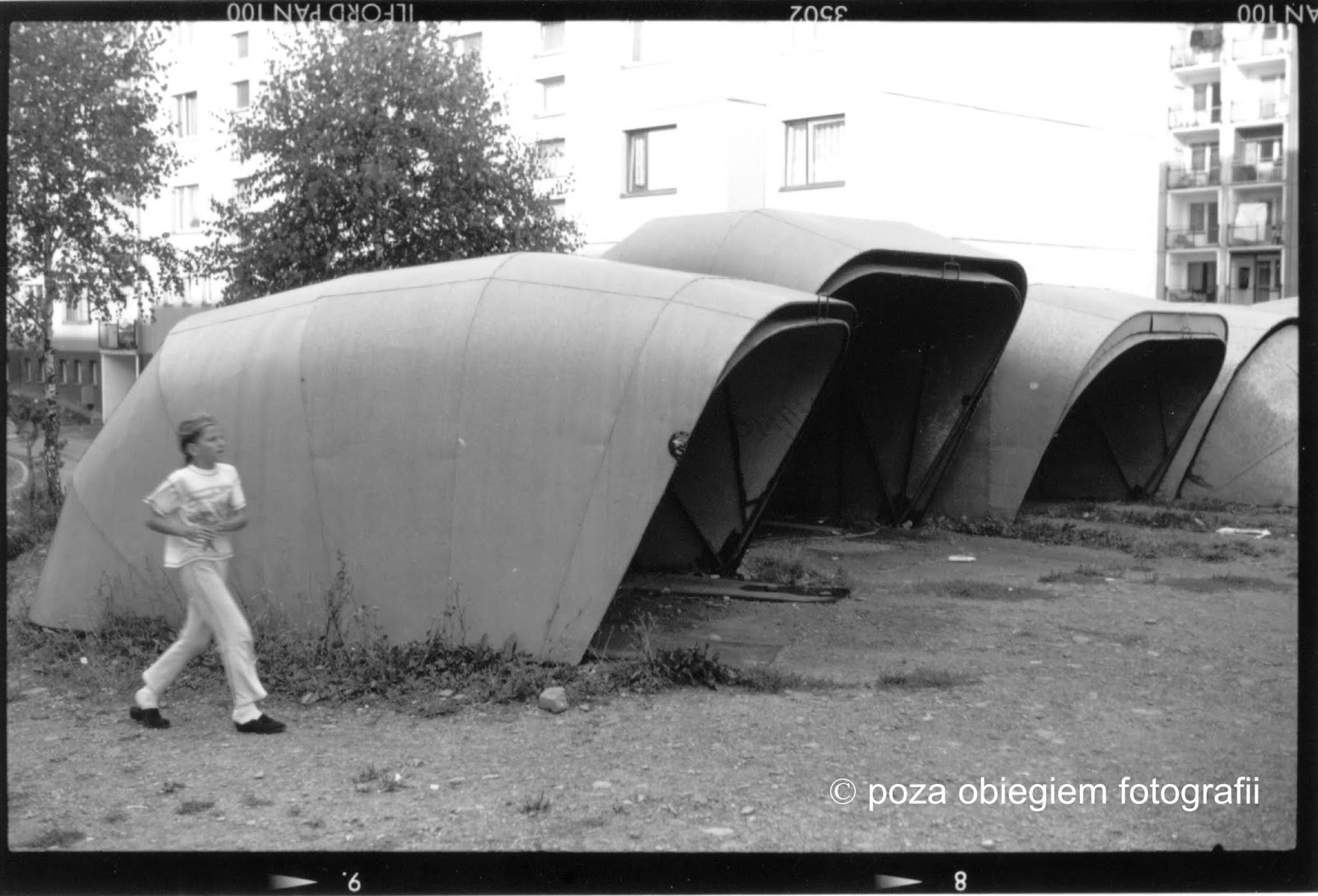
That day I made a trip to these small mountains near Bardejov. Nice, gentle hills, like in the Beskids on the Polish side of the border, perfect for a slow hike. Along the way, quiet and peaceful villages and settlements scattered among lightly forested mounds. Oddly enough, in the middle of the day these villages sometimes seemed dead or even abandoned. The townspeople went to work somewhere in the city? After the return of the route, in the late afternoon I made my way to a block of flats situated on a strange and small plateau above the old town, behind the church. There are some nice tin car garages that I wanted to photograph. The weather was even favorable, the garages in the rays of the setting sun, but unfortunately the changeability of the weather made itself felt. Well, there was a local pub located on the ground floor of one of the blocks to wait. A large hall, tables with metal legs, chairs too. In the corner, on the boom, a black and white TV set, fortunately turned off. Beer from a mug, but most of the locals also took something stronger as an accompaniment. The composition of the staff in the pub and its age shows that the housing estate was built for the working class some twenty-five years ago. All regular customers are probably retired or on a pension. When ordering a second beer, the barmaid - but the term buffet would be better - asks me what I have to sell. I do "big eyes" because I don't know what she means. It turns out that she took me for a Ukrainian. It means the camouflage is working. Old jeans, a plaid flannel shirt and clumsy beer ordering in Slovak with a foreign accent were enough.
Below are photos from this short trip to the hills near Bardejov.
Bardejov, church of St. The Apostles Cyril and Methodius, September 2003; scan from a color diapositive; camera: Pentax MG.
The church is currently on the UNESCO list of monuments.
Bardejov area, a modern chapel; Sep 2003; scan from a color diapositive; camera: Pentax MG.
niedziela, 20 czerwca 2021
Samsungi [80]
Warszawa, Wisła - widok z Mostu Poniatowskiego; zdjęcie wykonane - lato 2019r.; fot. telefon Samsung Galaxy J3, aplikacja do zdjęć czarno-białych wraz z rożnymi maskami.
Warsaw, Vistula river - view from Poniatowski Bridge; photo taken summer 2019; photo: Samsung Galaxy J3 phone, application for black and white photos with various masks.
piątek, 18 czerwca 2021
Rytm miasta [61]
Warszawa - Praga, kapliczka na jednym z podwórek; negatyw cz.b. Ilford Delta 400 Pro; aparat fotograficzny Ercona II.
Warsaw - Praga, a chapel in one of the courtyards; negative part b Ilford Delta 400 Pro; Ercon II camera.
czwartek, 17 czerwca 2021
Rytm miasta [60]
Warszawa - Praga, kapliczka na jednym z podwórek; negatyw cz.b. Ilford Delta 400 Pro; aparat fotograficzny Ercona II.
Warsaw - Praga, a little chapel in one of the courtyards; negative part b Ilford Delta 400 Pro; Ercon II camera.
środa, 16 czerwca 2021
wtorek, 15 czerwca 2021
Subskrybuj:
Posty (Atom)